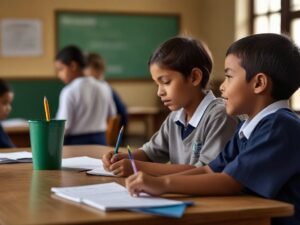
Bin Bag to school bag.
Across the developing world, millions of children between ages 5 and 16 remain out of school. Instead of classrooms, they endure markets, factories, and streets — robbed of their childhood and their future….

Education Initiative
B · B · S · B
A transformative program replacing child labour with quality education — turning discarded futures into bright ones, one child at a time.


"Every child deserves a desk, not a bin."
— MDF Mission
The Crisis
Across the developing world, millions of children between ages 5 and 16 remain out of school. Instead of classrooms, they endure markets, factories, and streets — robbed of their childhood and their future.
Girls are disproportionately affected. Poverty, distance, cultural barriers, and the demand for child labour create a cycle that, left unbroken, cascades across generations — holding entire communities in stagnation.
Without coordinated, on-the-ground action, entire states fall behind their developmental potential. This is not merely a humanitarian challenge — it is an economic and national security imperative.
By the Numbers
The Program
The Bin Bag to School Bag program is a comprehensive educational intervention designed to extract children from exploitative environments and integrate them into a structured, nurturing learning ecosystem.
BBSB is not just a school program — it is a complete transformation framework. It addresses academic learning, character formation, health education, and vocational readiness, ensuring every child emerges not only educated but empowered.
By establishing schools at community doorsteps, we eliminate the distance and cost barriers that prevent attendance. Multigrade, activity-based teaching methods ensure children of varying ages and backgrounds thrive together.
Program Objectives
Establish schools at community doorsteps, eliminating distance and cost barriers that keep children from education.
Reach marginalized and underserved populations with structured, certified learning in a safe environment.
Address academic, social, emotional, and physical development — nurturing the whole child, not just test scores.
Cultivate honesty, responsibility, respect, fairness, and empathy through structured character-formation activities.
Equip children with education and vocational skills to become economically independent, productive adults.
Facilitate seamless transition into formal education or vocational training for lifelong self-sufficiency.
Salient Features
Our Programs
A five-year primary education course designed for younger children, delivered through community-based schools. Builds foundational literacy, numeracy, and life skills in a safe, nurturing environment.
Ages 5–7 · 5-Year CourseA 30-month accelerated learning course equivalent to Grade 5 completion, designed for older out-of-school children. Enables rapid mainstreaming into formal schooling or vocational pathways.
Ages 8–16 · 30 MonthsMonitoring & Reporting
Momentum Development Foundation operates a robust M&E system overseeing every aspect of field implementation. Android-based real-time data collection feeds directly into PMU-level analysis, ensuring swift course correction and transparent outcomes.
Real-Time Android Monitoring
Field data captured digitally and transmitted instantly to the Programme Management Unit for analysis.
Teacher & Attendance Tracking
The system monitors teacher presence, learner attendance, and proper use of programme resources.
Periodic Reporting to Stakeholders
Monthly, quarterly, and end-term reports disseminated to all stakeholders including donors and government partners.
Take Action Today
Your contribution transforms a child working in streets and fields into a student with a future. Every rupee, every dollar counts.
Across the developing world, millions of children between ages 5 and 16 remain out of school. Instead of classrooms, they endure markets, factories, and streets — robbed of their childhood and their future….

“Literacy Plus is a comprehensive program designed to empower individuals through a structured journey towards holistic development.

An astounding 26.2 million children in Pakistan, ranging in age from 5 to 16, do not receive an education,